The many-headed serpent of the sea
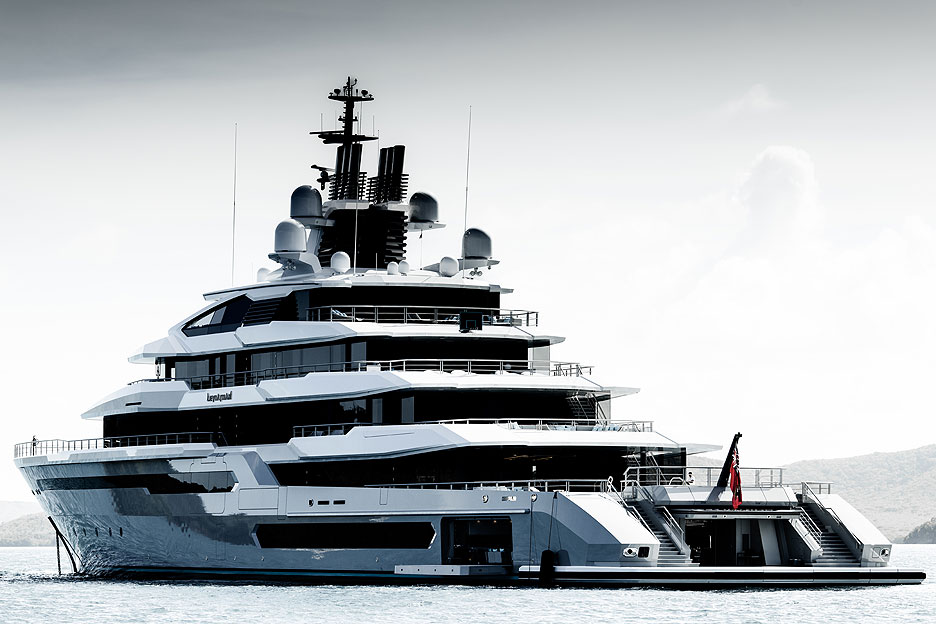
The yachting industry is a world of strange (sometimes) and gifted people. And here is a new character: the owner of a 111-meter yacht who was so inspired by the shipyard that built it that he went ahead and bought the shipyard as well. We are talking about Gabe Newell, the Dutch shipyard Oceanco, and the 111-meter yacht Leviathan.

The Lord of Gamers
The yachting industry hasn't seen a figure of this magnitude in a long time, perhaps never. Gabe doesn't come from the usual capital pools — no automotive industry, no commodities sector, no finance. Yes, he originally came from the tech industry, but even there he stands apart. He left Microsoft to found Valve, the creator of such video games as Half-Life and Counter-Strike 2, and the Steam platform, which was originally conceived as an internal marketplace and has long since become synonymous with online gaming.
In August 2025, Gabe — whom many know as the Lord — closed a deal with Mohammed Al-Barwani, who had owned Oceanco for the previous 15 years. At that time, his yacht Leviathan was being completed in the shipyard's docks, and Gabe, as the yacht owner, was actively involved in the process. Marcel Onkenhout, CEO of Oceanco, recalls: "We were welcomed into the team on an equal footing with Gabe and everyone who would later work on this yacht. It is this level of collaboration that sets Leviathan apart from everything we have built before. We are incredibly proud of how she was built and can say that this is the most comfortable yacht Oceanco has ever designed, built, and delivered."
And there is plenty to compare it with. Leviathan is the third longest yacht in the shipyard's portfolio, after the 127-meter sailing yacht Koru, built for Jeff Bezos, and the 117-meter Infinity.
A Flat Hierarchy
Gabe brought to the yacht the same management principle upon which Valve is built. The company has no team leads, no hierarchy of vice-presidents issuing quarterly plans from above. Gabe insists that he is not a boss, but an employee. A well-known approach, often imitated, but rarely truly reproduced.
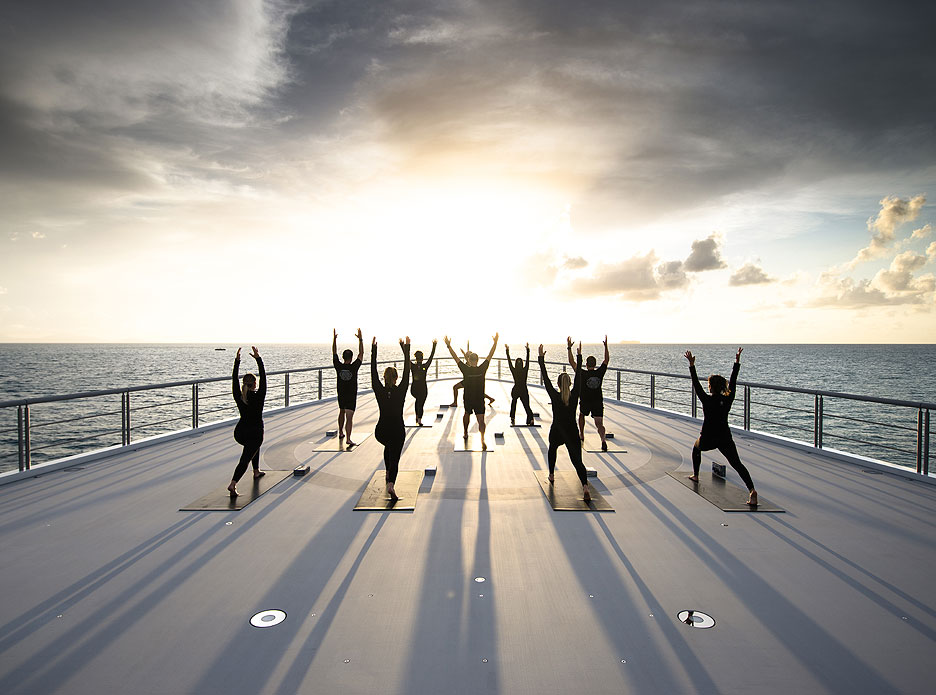
Interior designer Mark Berryman, whose portfolio includes such Lürssen yachts as Flying Fox and Arkley, diplomatically describes Gabe's innovative approach with the phrase "the project overturned established notions of the yacht's operational logic." Indeed, the guest quarters and open decks of Leviathan exist as shared spaces, not as backdrops past which the crew must move silently. On the central staircase, a glass panel is installed, engraved with the names of nearly three thousand people who built this yacht — from Oceanco workers and Y.CO brokers to designers at Mark Berryman Design and the crew. This is not a corporate gesture of gratitude after the fact. It is a design logic honed in game development, where you understand that a video game's success depends on every participant, whether a texture artist or a technical writer.

Decks Without Teak
The Oceanco team, led by Gilles Verne, incorporated all its winning design signatures into Leviathan's exterior: a slender, elegant bow, a low, open stern, a sharply defined midsection, clean yet futuristic deck lines, and a striking radar arch. The silhouette is not of the ultra-slim type that some shipyards are currently pursuing — Leviathan features powerful, stepped overhangs on the foredeck, aft, and along the side decks. Verne himself describes the silhouette as dynamic, emphasizing its crisp prismatic forms.
With a light grey hull, Leviathan's superstructure color is not white but off-white. It is easier for the crew to maintain. For the same reason, the railings have a matte finish, and the handrails are made of synthetic materials. If the yacht appears grey-white by day, in the evening its image gains a host of bright blue accents, including along the waterline. It is impossible to shake the feeling that this is the very blue that Valve's designers used in Half-Life 2 to mark areas safe for the player.
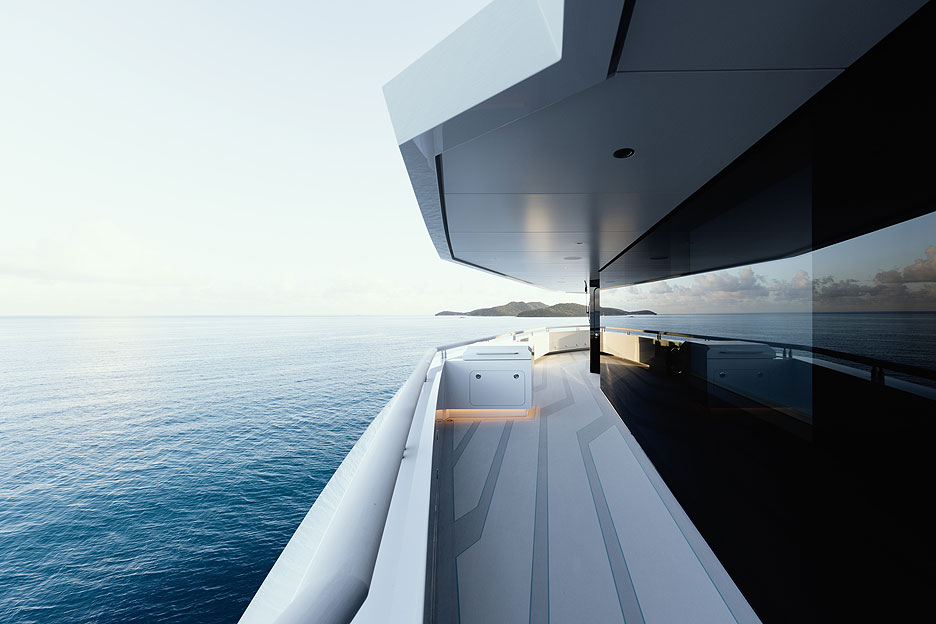
The deck covering is a story in itself. There is no teak here. On a yacht of this size, this is unusual, as it is not a fishing vessel where the main priorities are non-absorbent decks that are easy to clean. But Gabe seems to have no tolerance for decoration without purpose. For him, this is a utilitarian yacht; her decks are for living on, not for elegant promenading. The synthetic deck covering for Leviathan's open decks was developed in collaboration with Bolidt, featuring improved heat dissipation, making it comfortable to walk on barefoot even at midday in summer.
With a hull length of 111 m, Leviathan's gross tonnage just falls short of 5,000 GT (4,970). The reason is that exceeding the 5,000 threshold would trigger additional classification requirements, particularly when entering European marinas. And considering that Leviathan is far from the only yacht in Gabe's fleet, extra formalities during world travels are precisely what he does not need.

An Interior Without a Main Salon
While other brands with more compact yachts are doing away with formal dining areas on the main deck, Leviathan has dispensed with the main salon altogether. There is only a communal dining area seating 54. Typically, a yacht of this size would have a beach club adjacent to a spa and gym, but here these have been replaced by a dive center, a laboratory, an onboard hospital with a full-time medic, and a 3D-printing workshop where the crew prints spare parts during voyages. "Wake up, work, go diving" — this is how Gabe, an avid diver, describes his typical day. He lives and works aboard the yacht. And he has everything he needs for it.
On the bridge deck, there are 15 high-performance gaming PCs and two racing simulators. The latter were also designed by Gabe's team, only this time referring to his racing team, Heart of Racing — he is a car and racing enthusiast. The gaming area is not tucked away on the lower deck to avoid embarrassment; it becomes one of the main guest zones.
Interestingly, Oceanco moved the engine room with its diesel-electric propulsion system further forward than usual, thereby freeing up more space for guest cabins aft. For 26 guests, 11 comfortable cabins are arranged on board, including four VIP suites. The crew has even more — 13 cabins.
Captain Alan Pike, who previously served on the famous Octopus, summed up after sea trials: "The yacht handles beautifully. But what strikes me most is how quiet she is."

A Plan Without Empty Promises
If you compare the guest-to-crew ratio of Leviathan with other 100-meter yachts, it becomes clear that this is not a private yacht in the conventional sense. On similarly sized Oceanco yachts — Seven Seas, Bravo Eugenia — there are two to two-and-a-half crew members per guest. On Leviathan, it is one-and-a-half. This is not a shortage of service, but a consequence of the fact that Leviathan is part of the fleet of the research organization Inkfish, which Gabe founded in 2021. Inkfish provides scientists with access to remote waters and technologies that no university could afford. For instance, a deep-sea submersible from Gabe's fleet holds the record for the deepest manned dives in each of the five oceans.
It is known that Gabe is currently building two new research vessels at the Vard shipyard — one 100 meters and one 162 meters in length. Both are scheduled for completion by 2030.
"Yachts have enormous potential as platforms for scientific research," says Gabe. "The key is to realize that you are part of a larger community and to ensure that the yacht's presence creates value for the places it visits."

The World's Response
This, in essence, is Leviathan. Not Hobbes's Leviathan, not a political one, but the biblical one. Not a figure of power, but a metaphor for the World Ocean — vast and unexplored, into which it makes sense to venture well-prepared.
While working on Half-Life, Gabe formulated the following rule for his developers: when a player moves forward, something should happen in their surroundings every 3–5 seconds; the world should respond to them. It seems Gabe approaches life in much the same way.