


Resounding debut

Ares Yachts is still a very young company: the brand was registered in 2023 as a subsidiary of Ares Shipyard, which has been operating in Turkey since 2006, building coastguard vessels and patrol boats. So it is all the more interesting to get acquainted with the debut project of this new player — Ares Yachts was created specifically for the luxury segment. Plans were announced to build both sailing and motor yachts up to 90 m in length, but the first to leave the slipways was the classic sailing ketch Simena. Currently, several projects are being realised at the shipyard: the 50.55 m motor yacht Spitfire, the 54 m explorer Atlas, and the custom 70-metre Opal, which is at various stages of completion and will be launched in 2027, becoming the flagship of Ares Yachts.
For now, that position is held by the first and only yacht in the portfolio, the 62 m Simena, which, by the way, can boast another achievement — it is currently the largest sailing yacht designed and built in Turkey.

Aiming not just to recreate but also to "upgrade" the traditions of sailing shipbuilding, Ares Yachts turned to the Istanbul-based studio Taka Yacht Design, which designed the exterior and naval architecture of the vessel, virtuosically combining historical canons with modern technologies.
In the exterior, the aesthetics and design principles of the "golden age" of sailing ships were meticulously observed: Simena received a sharp, refined bow with a bowsprit, an elegant stern overhang (waterline length is 49.4 m), and a varnished wooden superstructure in retro style.
"Simena's appearance is inspired by the elegance of classic sailing yachts, but on a much larger scale and with modern proportions," says Tanju Kalaycıoğlu, founder of Taka Yacht Design. "The design is based on a smooth sheerline, a clipper bow, and the traditional ketch rig, which give the yacht a distinctive and recognisable silhouette."
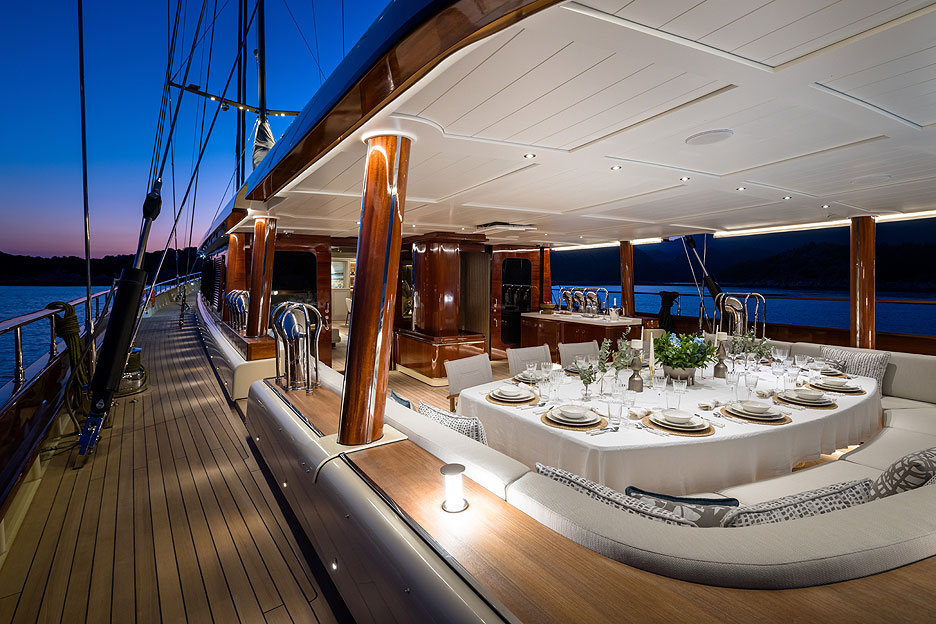
However, if you look at the underwater section of the vessel, there are clear signs of hull optimisation, as is done on all 21st-century yachts to improve efficiency. And the materials, of course, are modern: the hull is made of steel, while the low-profile superstructure, although finished externally with mahogany, is a composite structure. This weight distribution helped lower the centre of gravity — after all, the superyacht carries two impressive aluminium masts: the mainmast at 59.5 m and the mizzen at 48.7 m. Draught is 4.72 m, and displacement at full load is 570 tonnes.
Renowned sailing master Chris Mitchell was invited to design the rigging and sails. He is the founder of the Australian sailmaker Hansa Sailing but also develops sailing designs for other shipyards. Simena was designed as a Bermuda ketch, since fore-and-aft sails are not only easier to handle but also perform more effectively when sailing upwind than gaff rigs.

The sail package includes a 470 m2 mainsail, a 249 m2 mizzen, a 356 m2 staysail, and a 596 m2 genoa from Doyle Sails. Thanks to two furlable headstays, setting the foresails takes just minutes, and all sail handling operations are carried out with the push of buttons on the helm console.
In a following 20-knot wind, Simena reaches up to 16 knots under sail, while a comfortable cruising speed is considered to be 6 knots. Under power, her maximum speed is 15 knots, with a cruising speed of 11 knots.
A particular source of pride for the creators of this yacht is the hybrid propulsion system, which can operate in several modes. It consists of an MAN diesel engine producing 1,183 hp (882 kW), a 220 kW electric motor, and three CAT generators of 86 kW each. Using only the diesel engine, the yacht reaches 14–15 knots, and when maintaining an economical 9 knots, the range is 4,000 nautical miles. In fully electric (silent) mode, Simena can cover up to 6,000 nautical miles at 7–7.5 knots. In addition, when sailing under wind power from 7 knots upward, she can switch to energy regeneration mode: the controllable-pitch propellers generate enough electricity to supply all onboard systems.
Simena's garage is small and primarily designed for water toys, while a pair of tenders measuring 7.4 and 10 m are stowed on the foredeck, where a crane and cradle blocks are installed for them.
There are two ways to transfer people and supplies aboard. The traditional telescopic gangway at the stern is used when the yacht is berthed alongside a quay — since the transom is quite high above the water. When the vessel is at anchor, a hydraulic platform opens on the starboard side. It can serve not only as a landing stage for a custom limousine tender but also as a beach club: the 6 m2 area can accommodate sun loungers, and its location right at the waterline makes the terrace ideal for swimming.
For those who prefer a dip, there is also an oval pool/jacuzzi located aft and surrounded by sunbeds. Nearby is the cockpit with a dining area, bar, grill, and a retractable screen, so that al fresco movie nights can be enjoyed here in the evenings. The hardtop that provides shade is so seamlessly integrated into the superstructure roof that it forms a single whole with it.
And on this flat roof, a surprise awaits guests. A small flybridge has been arranged there, so skilfully integrated into the superstructure design that it is practically invisible and does not visually overload the yacht's profile. The duplicate upper helm station provides the helmsman with an excellent view, while the guest lounge is, conversely, shielded from outside glances, since the flybridge is slightly recessed relative to the superstructure roof.
Simena is ready to welcome 12 guests and nine crew members on board. At 62 m in length and with a maximum beam of 11.1 m, her interior volume is 499 GT, and the design of this not-so-small interior was entrusted to the prestigious British studio Design Unlimited.
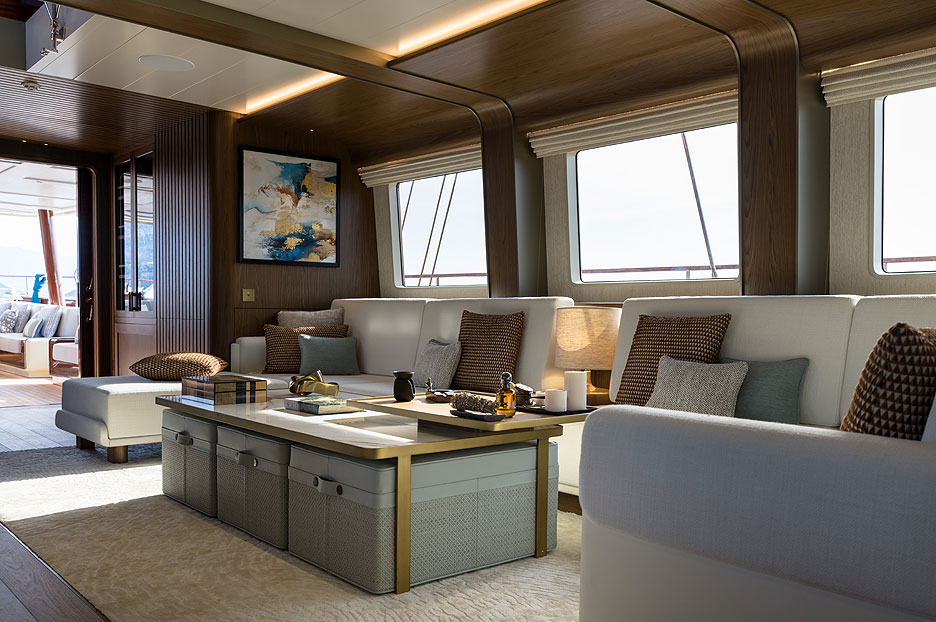
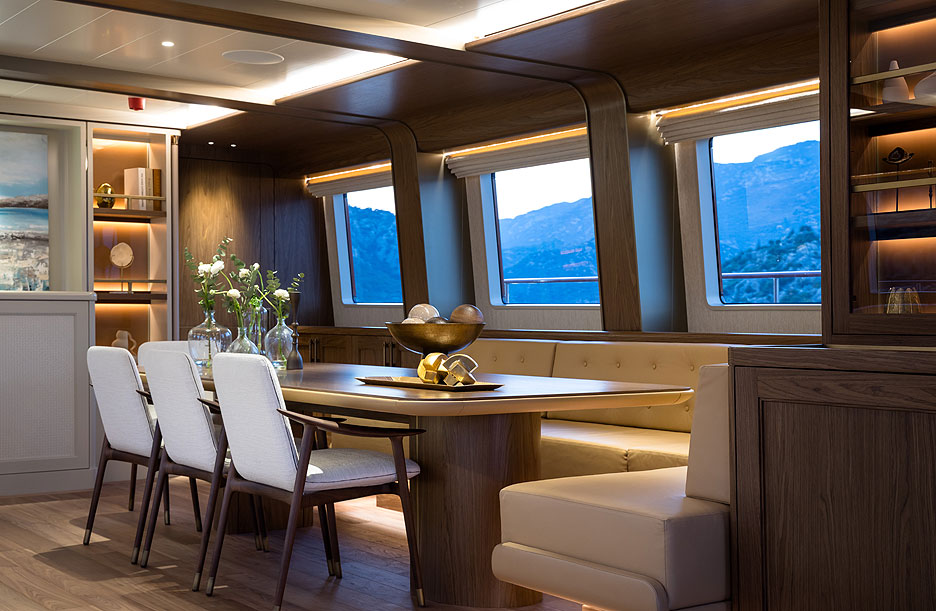
The foundation, as with the exterior, was good old-fashioned classic style, but with a contemporary twist. For instance, the salon recreates the atmosphere of a large sailing ship's wardroom: the large table can host formal dinners, while the low table by the spacious sofa is perfect for games over drinks from the bar. The decor of the coffee table, incidentally, is styled like treasure chests, adding a touch of "pirate" ambience. There is a television, but it is hidden inside a cabinet and only emerges when in use; for the rest of the time, the wall is adorned with a painted panel. Lighting is similarly concealed: illumination is present but soft, with light sources not drawing attention to themselves.

The master suite, occupying the forward part of the yacht, has a thoroughly modern design. The king-size bed has its headboard against a panel of glass and brass that separates the bedroom from the entrance. And an identical, half-transparent bulkhead serves as the boundary between the room and a decorative alcove where a beautiful oval bathtub stands. The lower part of the wall is designed as a cabinet that supports a television hidden inside it, while the transparent upper part visually adds volume to the space and allows, if desired, conversation with whoever is taking a bath at that moment. However, the actual bathroom, with washbasins, toilet, and shower, is located not here but at the entrance to the suite, next to the walk-in wardrobe.
Four guest cabins, including two VIPs and one twin, are located amidships and have mirror-image layouts. In addition, behind the central staircase there is another suite, conceived as a multifunctional space. It can serve as an additional cabin for guests or crew (should a larger team be required for a cruise or regatta), a study, or a games room.

All living spaces are finished in a beige-brown colour palette, with natural mixed-texture fabrics and beautifully finished leather in the décor, while the bathrooms feature fine grades of Calacatta Oro and Patagonia White marble and premium Gessi sanitary fittings.
The aft part of the yacht is a service area, where, in addition to the engine room and four crew cabins, there are a laundry, cold and freezer storage rooms, and a restaurant-grade galley. To avoid disturbing guests, a second deck access is also provided here.
Simena offers versatile cruising capabilities. Certification under RINA class allows the vessel to operate from the equator to high latitudes, meaning both in warm and humid climates and in winter conditions, with air temperatures down to minus 5°C.
Ares Yachts believes that with this project, Turkey will strengthen its position as a country capable of designing and building luxury superyachts.


